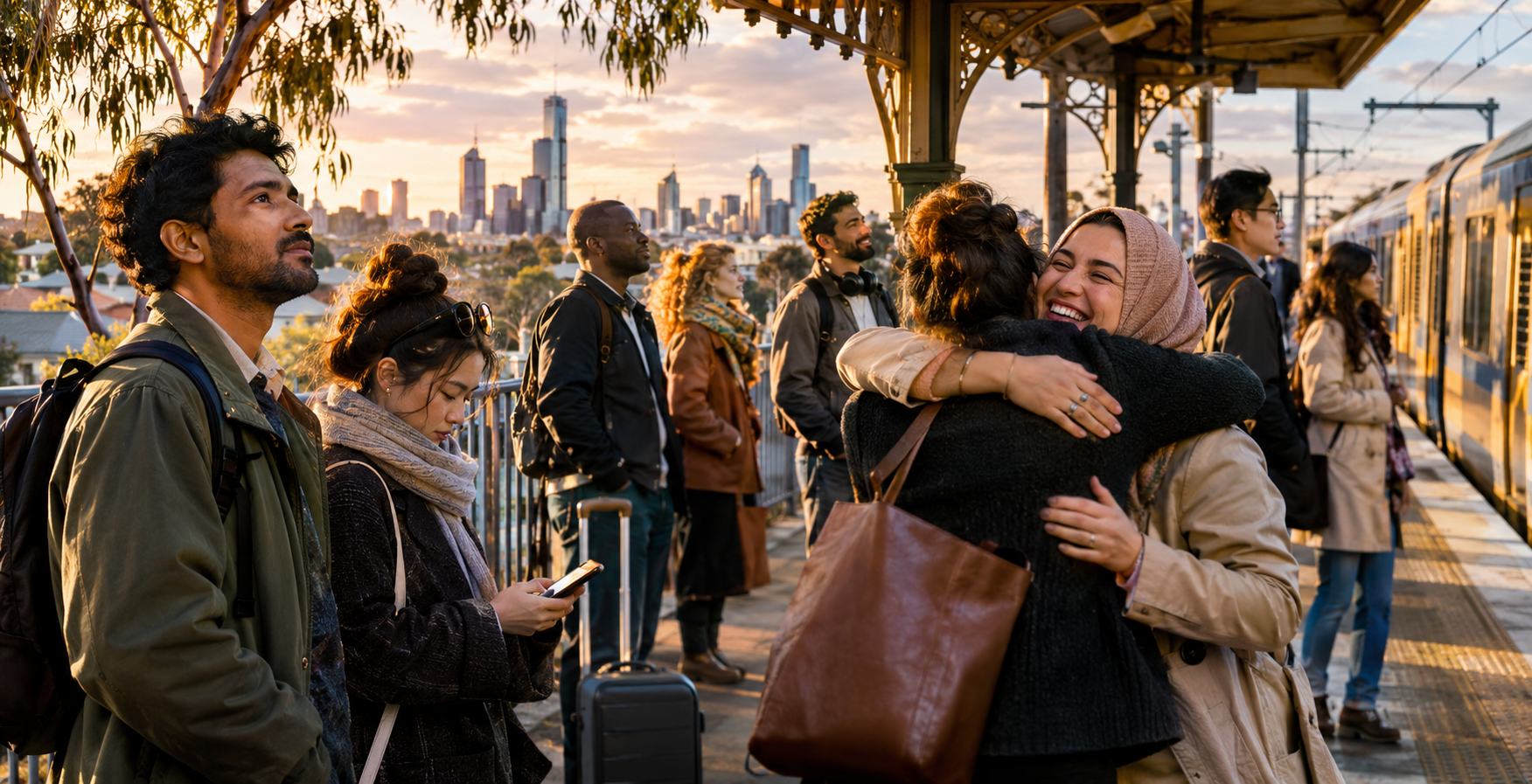
A person can learn their way around a new city long before they feel at home there. They know which train to catch, where to buy groceries and how to get through a working week. Yet when something goes wrong, they may still reach for the phone to call someone thousands of kilometres away.
Migration changes the practical details of life quickly. The emotional changes can take much longer.
In Australia, this is a question with wide relevance. At June 2025, 8.8 million residents were born overseas, representing 32 per cent of the population. India was the largest overseas country of birth, followed by England. These figures describe an enormously varied population, rather than a single migrant experience. (Australian Bureau of Statistics)
People arrive with different resources, expectations and reasons for leaving. Some have a job waiting and family nearby. Others begin with limited savings, uncertain work and nobody they can comfortably ask for help. Even within the same family, one person may settle happily while another continues to feel out of place.
So what allows a new country to become home?
Having your life and experience taken seriously
For migrants from developing countries, the conversation about belonging needs to make room for what happens to their working lives.
The term “developing countries” is broad. It cannot tell us someone’s education, income, race or circumstances. But it does invite a question worth asking: how much of a person’s previous life will be recognised when they arrive?
Someone may bring years of professional experience and still have to begin again. In the Scanlon Foundation Research Institute’s Multiculturalism in Focus study, interviewees described difficulties involving overseas qualifications, professional registration and demands for local work experience. Some moved into work below their previous skill level. The study included 65 qualitative interviews with people from China, India, Pakistan, Nepal, the Philippines and Iraq. Their accounts offer insight into particular experiences; they cannot establish how common those experiences are among all migrants. (Scanlon Foundation Research Institute)
There is an emotional cost to consider here alongside the lost income. A profession can be part of how a person understands themselves. When that experience seems to count for little, starting again can feel like having to prove that an earlier life actually mattered.
Professional standards are necessary. The question is whether pathways into qualified work are clear, proportionate and genuinely accessible. A person should be able to understand what is required, what it will cost and whether completing it offers a realistic route forward.
It is difficult to feel settled while remaining unsure whether the country has a place for the work you know how to do.
Racism changes the question of belonging
Homesickness and racism deserve separate attention.
Homesickness involves missing people, places and familiar ways of living. Racism involves being treated as lesser, suspect or unwelcome because of race or related prejudice. Someone can experience both, but describing racism as another adjustment difficulty understates what has happened.
The 2025 Mapping Social Cohesion report, based on a nationally representative survey of more than 8,000 Australian adults, describes continuing prejudice and discrimination towards immigrant and cultural groups, alongside resilient community connections. Both realities belong in an honest account of Australian life. (Mapping Social Cohesion 2025)
Consider what a welcome means if it seems to depend on a person’s name, accent, skin colour or religion. A friendly neighbourhood may provide genuine comfort, while discrimination at work leaves someone uncertain about their future. Feeling accepted in one setting does not cancel exclusion elsewhere.
Telling a person to be more confident or make more friends is inadequate when the problem is how others treat them. Employers need to take discrimination seriously. Colleagues and neighbours have a responsibility to challenge it rather than leave the person affected to carry the whole burden.
A migrant should also be able to speak about unfair treatment without having their gratitude questioned. Appreciating opportunities in Australia and wanting fair treatment are entirely compatible.
The money behind the feeling
Belonging can sound abstract until the rent is due.
For a migrant whose savings are limited, the cost of establishing a household can narrow almost every choice. If they are also supporting relatives overseas, one income may need to cover responsibilities in more than one country. Further study, professional assessments or a visit to an ageing parent may compete with ordinary living expenses.
These circumstances do not apply to everyone arriving from a developing country, and financial difficulty is hardly confined to migrants. Still, they matter when we ask why someone has not yet built a social life or found their footing.
An invitation may be welcome and still be unaffordable. A community activity may be nearby but impossible to attend around irregular shifts. Advice to visit family more often means little when flights would consume months of savings.
There is also a particular strain in being unable to help in person. When a parent becomes ill overseas, distance becomes a practical problem involving money, leave and care arrangements.
Any serious discussion of belonging should leave room for these constraints. Stable work and manageable housing costs give people more freedom to participate in the places where they live.
Moving from Britain, Ireland or the United States
Migrants from wealthier, English-speaking countries belong in this conversation too.
A shared language may make some parts of settling easier. It does not supply close friendships, replace family support or guarantee that the life someone imagined will suit them.
Research published in 2012 on British return migration explored how family ties, homesickness, disappointed expectations and a lack of belonging shaped some migrants’ decisions to leave Australia. It drew on an online discussion forum, so it should not be read as a measure of British migrants generally. It does, however, show why a move that looks attractive from the outside may feel quite different to the person living it. (Holmes and Burrows)
Patricia O’Connor’s work on Irish belonging in Australia also considers the relationship between the personal feeling of being at home and wider experiences of inclusion and exclusion. That distinction helps explain why cultural familiarity alone cannot settle the question. (O’Connor, 2013)
Someone arriving from the United States deserves the same attention to their individual circumstances. We should ask about their relationships, work and sense of connection rather than assume that speaking English makes the transition easy.
None of this makes every migrant’s difficulties equivalent. Nor does a British, Irish or American birthplace establish someone’s race. A Black British migrant and a white British migrant may encounter different treatment in Australia despite holding the same nationality.
Recognising homesickness among migrants from wealthy countries should broaden the conversation while preserving an honest account of unequal treatment.
What helps a place become home?
There are ordinary, practical ways to make settling less lonely.
An invitation becomes more meaningful when it is repeated. Learning to pronounce someone’s name properly shows care without requiring a grand gesture. Explaining an unfamiliar workplace practice can spare a newcomer the embarrassment of having to guess.
In the Scanlon qualitative study, participants described belonging through local relationships, mutual help and involvement in their communities. Receiving support mattered, but so did being able to offer it. (Scanlon Foundation Research Institute)
That last point deserves attention. Newcomers should have opportunities to contribute without being expected to earn basic acceptance. Someone can need help with one part of life and have plenty to offer in another.
There should also be room to retain earlier attachments. Speaking another language at home, maintaining religious traditions or keeping close ties overseas need not prevent someone from building a meaningful life in Australia. A person does not have to stop loving one place before another begins to matter.
In Australia, this discussion also requires respect for Aboriginal and Torres Strait Islander peoples’ distinct relationship with Country. Migrant belonging sits within a longer history. It should not be used to flatten that history into a claim that everyone arrived in the same way.
For some people, Australia will become the place they want to grow old. Others will return to their country of birth or build lives connected to several places. Those choices deserve more understanding than the language of success and failure allows.
A useful test of belonging is whether someone can imagine an ordinary future where they live: work that offers a fair chance, relationships they can rely on, and enough security to make plans. They should be able to bring their history into that future without having it dismissed, and to raise concerns about their new country without being told that they should leave.